Chandigarh Phase III FAR Rises from 1.2 to 3.0: What Property Owners in Sectors 48–63 Should Expect
Eligible vacant group-housing plots in Phase III may now build to FAR 3.0 and eight storeys. Which plots qualify, what it does to development potential — and why it is not a price guarantee.
Chandigarh is known for its planned sectors and controlled urban development. But as housing demand grows and developable land remains limited, the city is exploring ways to accommodate more homes within its existing boundaries.
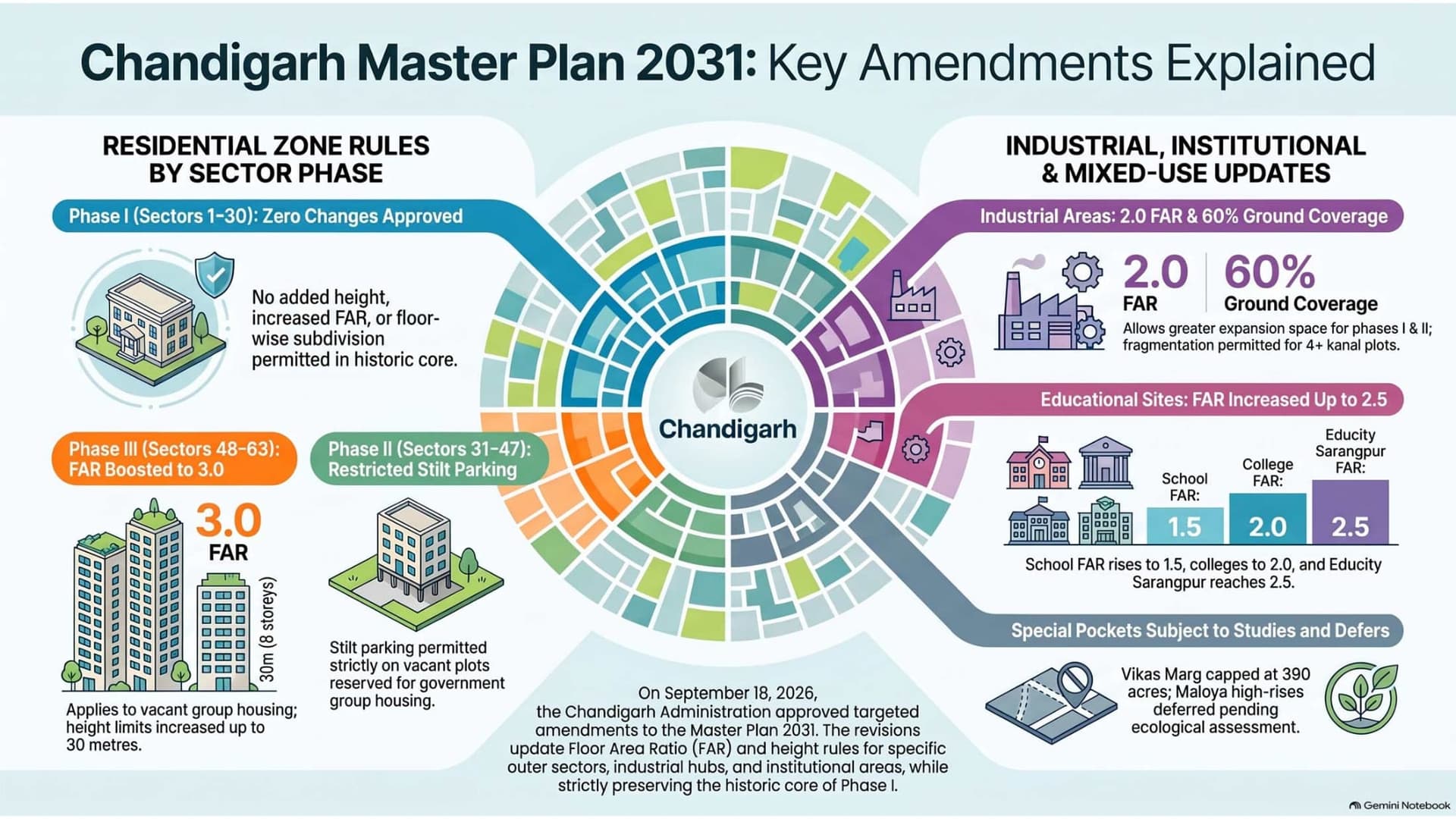
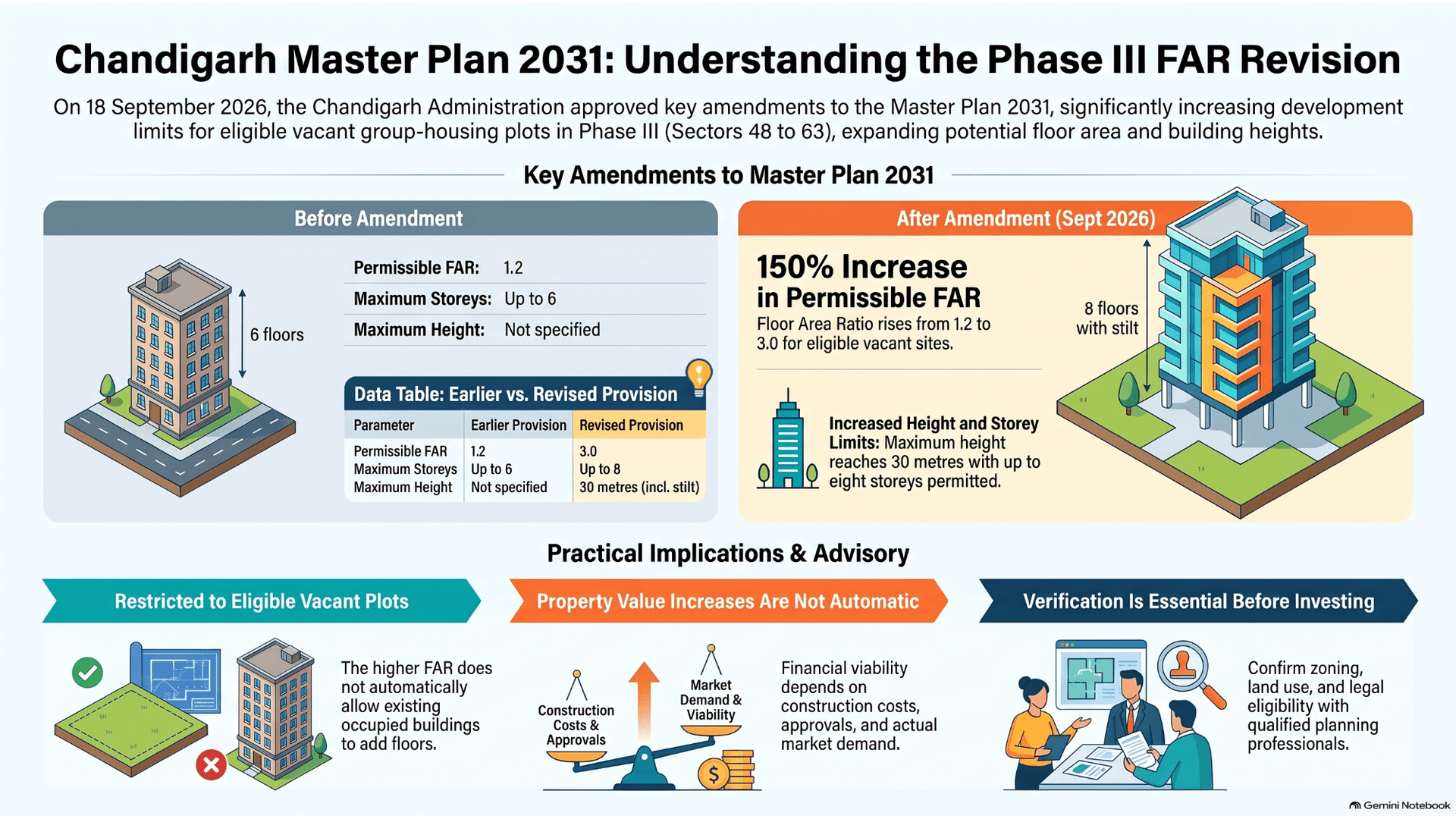
One of the most significant recent changes concerns Phase III, covering Sectors 48 to 63. On 18 September 2026, the Chandigarh Administration approved amendments to the Chandigarh Master Plan 2031 that increase the permissible floor area ratio (FAR) for eligible vacant group-housing plots from 1.2 to 3.0. The reported maximum building height also rises to 30 metres, inclusive of stilt, with up to eight storeys permitted under the revised provisions.
The change could create new development opportunities in parts of southern Chandigarh. However, it does not mean that every existing building can add floors, or that every property in these sectors will automatically become more valuable.
For homeowners, buyers and investors, the important questions are which plots qualify, how the rules will be implemented, and whether additional development will translate into meaningful market opportunities.
1. What has changed under the revised Master Plan?
The approved amendments increase FAR from 1.2 to 3.0 for vacant group-housing plots in Phase III. The reported development parameters are:
| Parameter | Earlier provision | Revised provision |
|---|---|---|
| Permissible FAR | 1.2 | 3.0 |
| Reported maximum storeys | Up to 6 | Up to 8 |
| Maximum reported height | — | 30 metres, inclusive of stilt |
| Scope | Applicable existing rules | Eligible vacant group-housing plots |
Source: The Tribune's reporting on the Chandigarh Master Plan 2031 amendments approved on 18 September 2026.
The FAR increase represents a 150% rise in the permitted floor-area ratio. In simple terms, eligible sites may be able to accommodate substantially more floor space than before.
However, the exact development potential of an individual plot will depend on the applicable building regulations, plot dimensions, ground coverage, setbacks, parking requirements, fire-safety provisions and other approvals.
The May 2026 draft had contemplated more expansive development, including buildings approaching ten storeys in certain proposals. The approved version was more restrained, after the Administration considered objections and the recommendations of its Screening Committee.
2. What does FAR 3.0 mean in practical terms?
FAR, or floor area ratio, measures the total permitted floor area of a building relative to the area of its plot.
For example, consider a hypothetical group-housing plot measuring 10,000 square metres:
- At FAR 1.2, the permitted floor area would be 12,000 square metres.
- At FAR 3.0, the permitted floor area would be 30,000 square metres.
That is an additional 18,000 square metres of potential floor area, before considering other applicable restrictions. This example illustrates the mathematical effect of the change; it is not a development calculation for any actual Chandigarh property.
A higher FAR may allow an eligible developer to construct more residential floor space on the same site. Depending on the approved layout, this could support more apartments or larger residential buildings.
But FAR does not determine the number of flats by itself. The final number depends on apartment sizes, building design, circulation areas, parking, open spaces, infrastructure capacity and applicable planning requirements.
The key distinction: FAR 3.0 creates greater potential for development. It does not guarantee that the entire theoretical floor area can be constructed or sold.
3. Which areas could benefit?
Phase III covers Sectors 48 to 63, but the revised provision is specifically linked to eligible vacant group-housing plots. This distinction is important for owners of existing houses, apartments and residential society units.
A property being located within Sector 48, 53 or 63 does not automatically establish eligibility for the higher FAR. The plot's land-use classification and the rules applicable to that site must be verified.
For buyers considering property in these sectors, the first step should be to establish whether the development potential being advertised is supported by the applicable planning documents.
For existing apartment owners, the amendment should not be interpreted as an automatic right to add floors to an occupied building. Redevelopment or additional construction may require separate approvals and compliance with building regulations.
4. Sector 53: housing demand and new development potential
Sector 53 provides useful context for understanding Chandigarh's housing requirements.
In April 2026, reporting by The Tribune said the Urban Planning Department had approved a stilt-plus-six-floor plan for a Chandigarh Housing Board (CHB) general housing scheme. The plan envisaged approximately 500 flats across two plots measuring 4.5 acres each, with private developers expected to participate through an auction process.
The proposed development followed several years of uncertainty surrounding the scheme.
A demand survey completed in March 2025 had received 7,468 applications for 372 proposed flats — approximately 20 applications per unit. However, the scheme had also encountered difficulties in earlier iterations, when high proposed prices contributed to weak demand.
These figures reveal two important aspects of Chandigarh's housing market. First, there can be substantial interest in new housing opportunities in selected locations. Second, demand depends on affordability, pricing and the type of property being offered.
The Sector 53 scheme should not be confused with the new FAR provision. Its reported stilt-plus-six-floor approval predates the September Master Plan amendments, and the amendment does not by itself establish the final design or approval status of this project.
For prospective buyers, Sector 53 is therefore an example of the city's evolving housing supply — not proof that every Phase III site will be redeveloped.
5. Sector 63: what recent Housing Board auctions tell us
Sector 63 also provides a useful indication of what buyers are prepared to pay for certain existing residential properties.
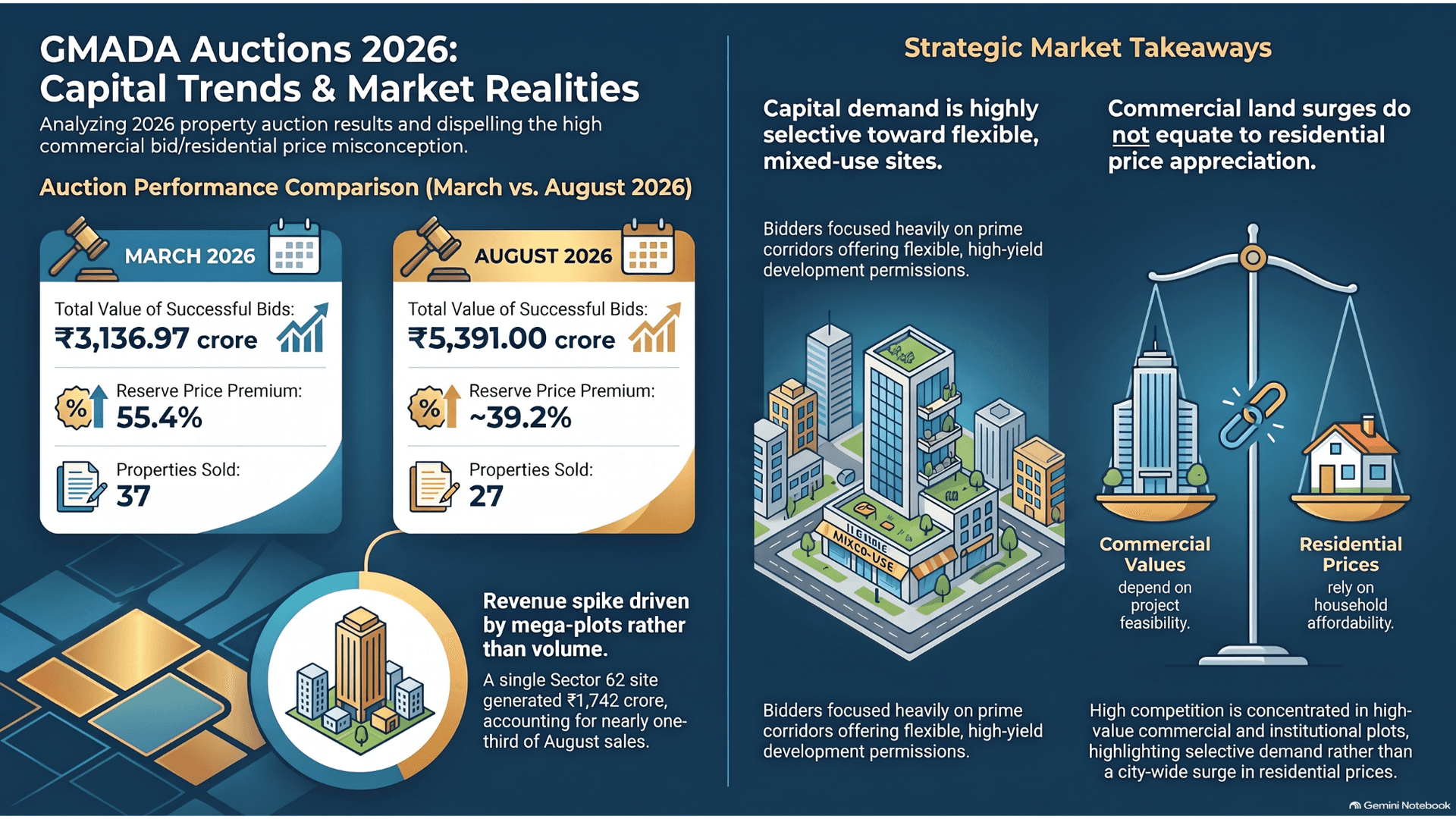
In September 2026, the Chandigarh Housing Board sold two two-bedroom flats through an e-auction for ₹1.92 crore and ₹1.89 crore. Both exceeded their reserve price of approximately ₹1.29 crore by around ₹60 lakh.
At the same time, the wider auction produced a mixed result: 12 of the 14 residential properties offered remained unsold.
The outcome is significant because it illustrates why property markets must be assessed carefully. Some properties can attract strong bidding, while others fail to secure buyers at their reserve prices.
The two Sector 63 transactions are evidence of buyer interest in those specific flats at those prices. They are not sufficient to establish the average market value of Sector 63 properties, nor do they demonstrate that the FAR amendment caused prices to increase.
For buyers, recent registered transactions and auction results can provide useful reference points, but the comparison should account for property size, floor, condition, ownership status and other relevant characteristics.
6. Will FAR 3.0 increase property prices in Sectors 48–63?
A higher FAR can improve the development potential of an eligible vacant plot. In some circumstances, that may increase its attractiveness to developers. However, the relationship between FAR and property value is not automatic.
The financial benefit depends on several factors:
- Eligibility. The site must fall within the category covered by the revised provision.
- Construction costs. Additional floor space requires investment in construction, services, lifts, fire safety and other building systems.
- Infrastructure. Roads, parking, water supply, sewerage and other services must support the proposed development.
- Market demand. More permissible floor space is valuable only if buyers or tenants are willing to pay for the resulting homes.
- Approvals. Applicable zoning, building regulations and project-specific permissions must be satisfied.
- Competition. Additional supply may create more choices for buyers and could affect pricing in particular segments.
A developer may be able to build more apartments on an eligible site, but whether the project is financially viable will depend on the total cost of development and the prices achievable in the market.
Similarly, owners of existing apartments should not assume that their property's value will rise in direct proportion to the FAR increase. The change applies to a particular category of plots, not automatically to every residential unit.
7. Could more housing improve affordability?
Increasing permissible development capacity can help a city accommodate additional housing without relying entirely on expansion into new areas.
If eligible sites are developed and new homes reach the market, buyers could eventually have more options. The effect on affordability, however, will depend on the location, apartment sizes, construction costs and prices at which the homes are offered.
New developments may be positioned in the premium segment rather than serving first-time buyers or lower-income households.
The Sector 53 demand survey illustrates the complexity. Although the reported response was substantial, the history of the scheme also shows that proposed prices can affect whether demand translates into actual purchases.
The practical outcome will therefore depend not just on how many additional homes can be built, but also on what those homes cost and which buyers they serve.
8. What property owners and buyers should do now
If you own property or are considering a purchase in Sectors 48 to 63, take the following steps before making assumptions about future development potential.
- If you own a group-housing plot. Ask a qualified architect or planning professional to confirm whether the plot is covered by the revised FAR provision, and how much floor area can legally be developed.
- If you own an existing apartment. Do not assume that the amendment gives you the right to add floors, or that your society can automatically undertake redevelopment. Check the applicable rules, ownership structure and approval requirements.
- If you are buying a property. Treat claims about FAR 3.0, additional floors or future redevelopment as unverified until supported by the relevant planning documents.
- If you are considering a development investment. Prepare a feasibility assessment covering construction costs, approvals, parking, infrastructure, financing and realistic sale prices.
- If you are comparing properties. Review recent registered transactions and auction results for comparable units. Avoid using a single high-value transaction as the benchmark for an entire sector.
Before proceeding, verify the latest applicable notifications and building regulations with the Chandigarh Administration, and obtain professional advice specific to the property.
A significant planning change, not an automatic price guarantee
The increase in FAR from 1.2 to 3.0 is an important development for eligible vacant group-housing plots in Chandigarh's Phase III.
It creates the possibility of greater residential floor space and taller buildings within selected sites in Sectors 48 to 63. It may also encourage developers to reassess the feasibility of projects that were less attractive under the earlier development limits.
But the ultimate effect will depend on implementation, site eligibility, infrastructure, construction costs and housing demand.
The Sector 53 housing proposal and recent Sector 63 auction results provide useful context, but neither guarantees future appreciation. They show why buyers must look beyond headline figures and examine the specific property and its market.
For homeowners, investors and prospective buyers, the most important step is to establish exactly what the revised rules permit on the site under consideration.
At Garahpravesh, our objective is to explain Chandigarh's changing property regulations in practical terms, helping buyers and owners make informed decisions based on verified information rather than assumptions about future prices.
References
- The Tribune, “Chandigarh Admn clears Master Plan 2031 changes”, 18 September 2026 — the FAR, height and storey provisions.
- The Tribune, April 2026 — the Chandigarh Housing Board stilt-plus-six scheme in Sector 53 and the March 2025 demand survey.
- Chandigarh Housing Board e-auction results, September 2026 — the two Sector 63 flats and the unsold lots.
Disclaimer: this article is for general informational purposes only and does not constitute legal, financial or investment advice. The revised FAR provision is reported to apply to eligible vacant group-housing plots. Verify the latest official notifications, applicable building regulations and plot-specific approvals with the Chandigarh Administration before making a property decision.