Chandigarh: Why the City Beautiful Has Become One of India’s Most Coveted Property Markets
A Sector 9-A bungalow reportedly sold for ₹126 crore. What that says about Chandigarh’s limited land and its premium sectors — and what it does not say about the price of an ordinary home.
What makes a residential property worth ₹126 crore?
In Chandigarh, the answer goes beyond the size of the house or the amenities it offers. It is also about location, limited land availability, exclusivity and the value attached to owning property in one of India's best-known planned cities.
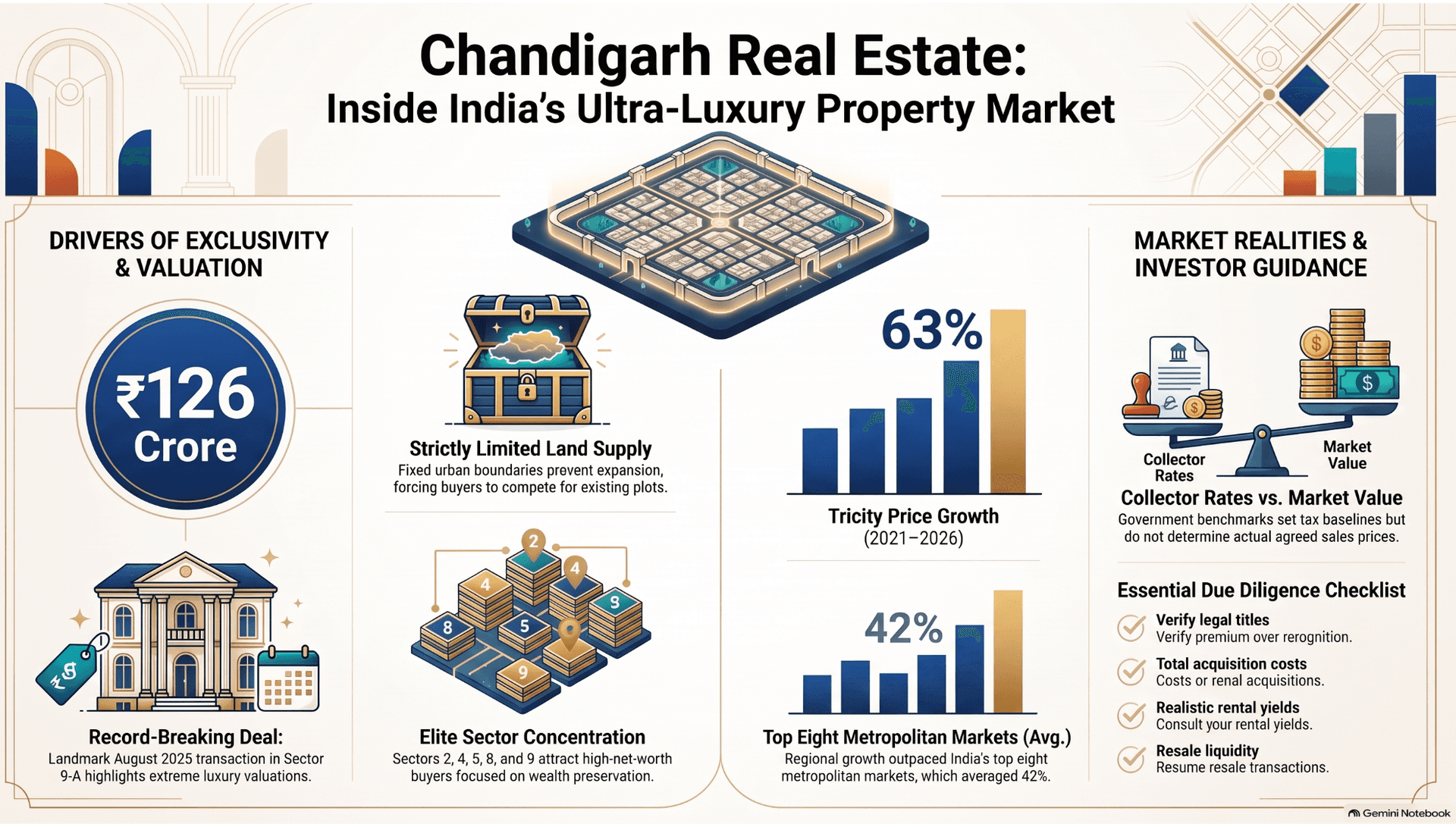
In August 2025, a residential property in Sector 9-A, Chandigarh, reportedly changed hands for approximately ₹126 crore. The transaction attracted attention because of its extraordinary value, and highlighted the premium that certain properties in the city can command.
Another residential property in Sector 9-B was reportedly registered for ₹100 crore in May 2026, reinforcing the attention surrounding Chandigarh's luxury housing market.
These transactions raise an interesting question: what makes Chandigarh property so valuable, and what do these record-breaking deals tell us about the city's real estate market?
The answer lies in a combination of urban planning, restricted land supply, location advantages and demand from buyers seeking premium residential addresses.
1. Chandigarh's biggest advantage: limited land supply
Unlike many rapidly expanding cities, Chandigarh operates within clearly defined planning boundaries. Its carefully planned urban structure and limited availability of developable residential land distinguish it from neighbouring markets.
When demand increases but the supply of comparable properties remains constrained, prices in sought-after locations can face upward pressure.
This is particularly relevant in established residential sectors, where buyers may be competing for existing properties rather than choosing from a large supply of newly developed residential land.
However, limited supply does not mean every property automatically appreciates. The condition of the building, plot size, sector, permissible land use, ownership documentation and prevailing demand all influence the value of an individual property.
For buyers, the key attraction is the opportunity to own property in an established urban environment where comparable alternatives may be limited.
2. Why Sectors 2, 4, 5, 8 and 9 attract premium buyers
Chandigarh's premium residential market is not uniform. Certain sectors have developed a reputation for high-value homes, larger plots and established residential surroundings.
Sectors such as 2, 4, 5, 8 and 9 are associated with some of the city's most sought-after residential addresses. Properties in these locations can command substantial prices depending on plot size, condition, location within the sector and the terms of the transaction.
For affluent buyers, the attraction may extend beyond the property itself. An established address, proximity to key parts of the city, the character of the neighbourhood and the scarcity of comparable homes can all contribute to perceived value.
This also explains why a large independent house in an established Chandigarh sector cannot be compared directly with an apartment in a newly developed township in Mohali or Zirakpur. They represent different property categories, buyer segments and ownership experiences.
3. The role of affluent buyers and wealth preservation
Chandigarh attracts interest from business owners, professionals, established families and buyers seeking premium residential properties.
For some high-net-worth individuals, real estate forms part of a broader wealth-preservation strategy. A property in a sought-after location may appeal to buyers who value tangible assets, long-term ownership and a prestigious address.
However, a high-value transaction does not necessarily represent the experience of the wider market. A handful of luxury property registrations can make headlines without indicating equivalent demand across middle-income housing, apartments or smaller residential plots.
It is therefore important to distinguish between Chandigarh's ultra-premium property segment and the market faced by an ordinary homebuyer.
The ₹126 crore transaction demonstrates the prices that exceptional properties can command. It does not establish the average price of a Chandigarh home, or prove that all properties in the city are appreciating at the same rate.
4. Collector rates and actual market prices: understanding the difference
Another important factor in Chandigarh's property market is the relationship between collector rates and actual transaction values.
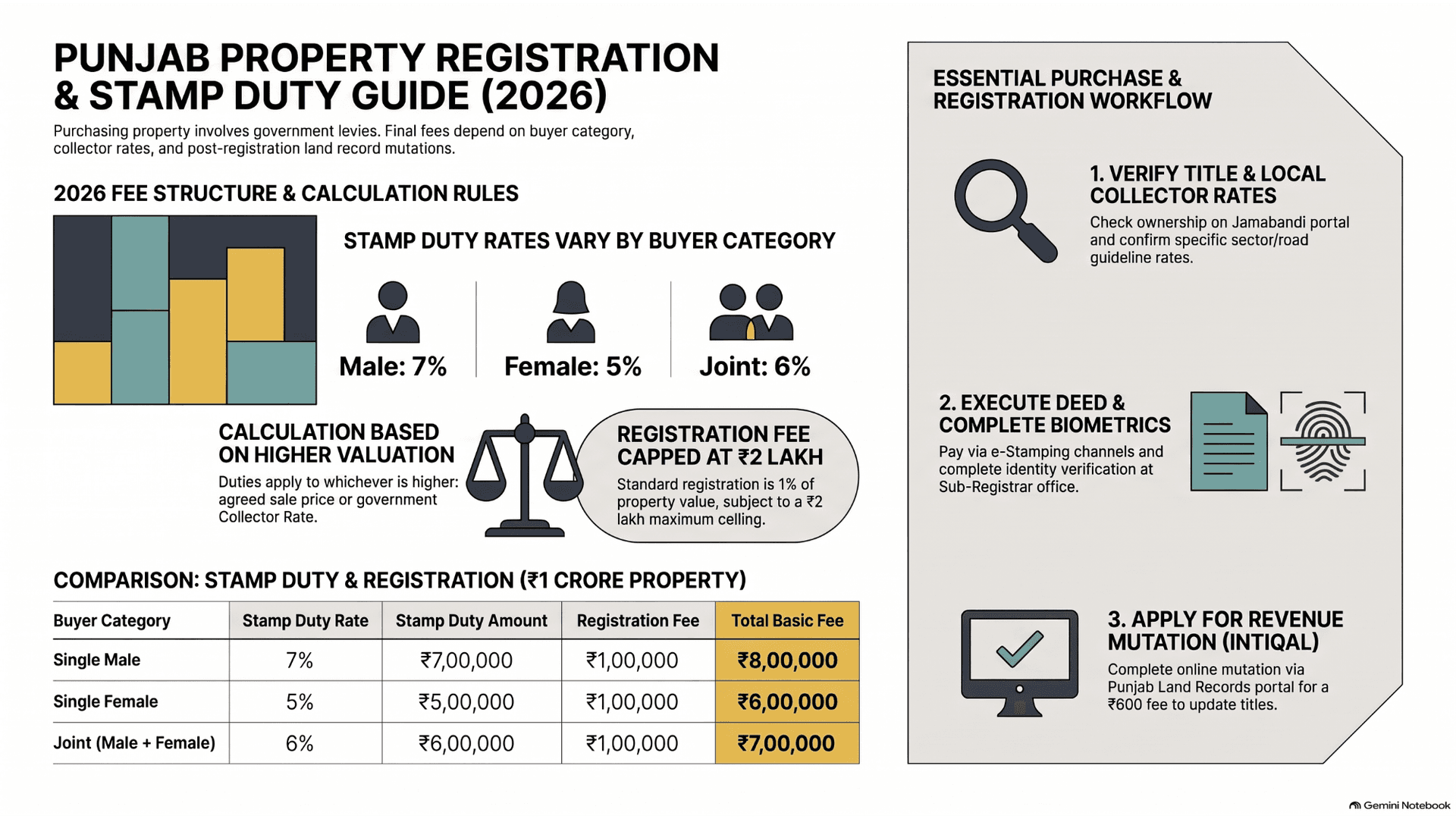
Collector rates are government-notified valuation benchmarks used for determining stamp duty and registration charges, subject to applicable rules. They are not the same as the price a willing buyer and seller agree upon in an open-market transaction.
When collector rates are revised, the cost of registering property can change. Such revisions may also influence sellers' expectations and buyers' calculations. But an increase in collector rates does not automatically translate into an equivalent increase in market value.
For anyone evaluating a property in Chandigarh, it is essential to examine recent comparable transactions, the property's legal status, applicable registration charges and its actual market demand.
This distinction becomes especially important when a headline-making luxury deal is used as a benchmark for a different property.
5. Is Chandigarh's property market outperforming the rest of the Tricity?
Chandigarh's premium residential market is closely connected to the wider Tricity region, which includes Mohali, Zirakpur, Panchkula and other surrounding areas. However, the markets should not be treated as interchangeable.
Chandigarh has an established urban structure and limited land supply. Mohali and Zirakpur offer a wider range of newer residential developments, including apartments, gated communities and under-construction projects. Panchkula has its own established residential neighbourhoods and developing areas.
A September 2026 report covered by The Tribune cited a 63% increase in residential property prices across the Chandigarh Tricity region between 2021 and 2026, compared with 42% across India's eight largest metropolitan markets.
That figure offers useful context for understanding the region's broader property market. It should not, however, be presented as a 63% increase in Chandigarh city alone.
The distinction matters because a luxury bungalow in Sector 9, an apartment in Mohali and an under-construction project in Zirakpur serve different buyers and follow different market dynamics.
For prospective buyers, the more useful question is not simply which city has recorded the highest growth. It is which locality and property type best fit their budget, intended use and investment horizon.
6. The other side of the market: affordability
Record-breaking property deals can create the impression that Chandigarh real estate is an ever-rising market. The reality is more complicated.
For salaried households and first-time buyers, purchasing a property in Chandigarh may be financially challenging, particularly in premium residential sectors.
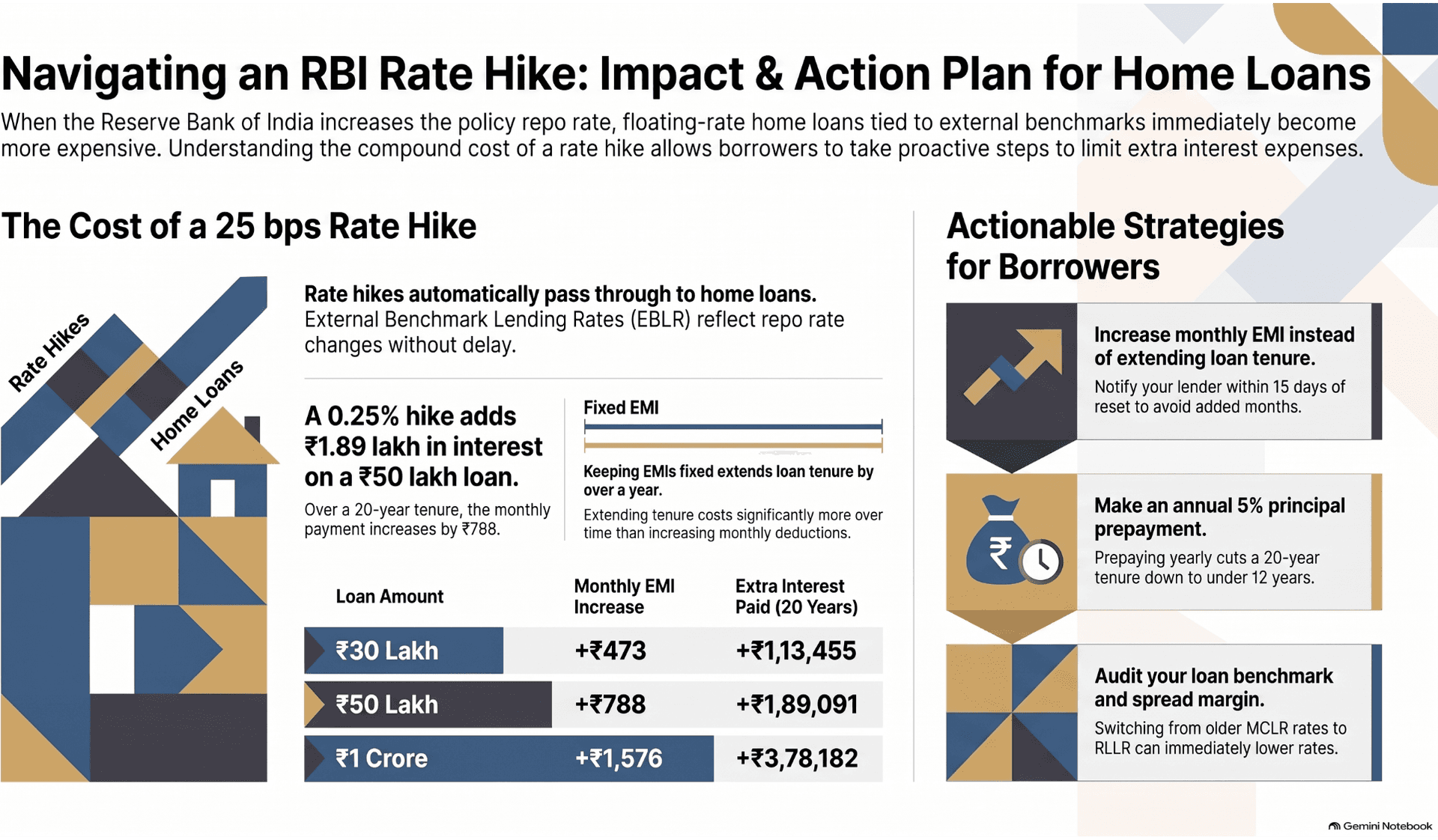
Higher purchase prices require larger down payments and can translate into substantial home-loan EMIs. Buyers must also account for stamp duty, registration, maintenance, repairs and other ownership expenses.
This is one reason neighbouring markets have become important alternatives for people who want to live in the Chandigarh region without paying the price of an equivalent property in the city's premium sectors. Depending on the locality and property category, Mohali, Zirakpur and Panchkula may offer more suitable entry points for buyers with different budgets.
Nevertheless, affordability should not be judged by the initial price alone. Commuting costs, infrastructure, construction quality, maintenance expenses and resale prospects also affect the overall value of a purchase.
7. Should you invest in Chandigarh property?
Chandigarh's limited land supply and established premium neighbourhoods can make certain properties attractive to long-term buyers. But a prestigious address alone is not sufficient reason to invest.
Before purchasing, consider the following:
- Location and comparable transactions. Compare the asking price with recent transactions involving similar properties in the same sector. Avoid using exceptional luxury deals as the benchmark for ordinary residential properties.
- Legal due diligence. Verify ownership, title documents, encumbrances, applicable land-use restrictions, building approvals and other requirements relevant to the specific property.
- Total acquisition cost. Include stamp duty, registration charges, brokerage, renovation, maintenance and financing costs in your calculations.
- Rental potential. If you are buying for rental income, assess realistic achievable rent, vacancy risk, ongoing expenses and net rental yield rather than relying on assumptions about future appreciation.
- Resale liquidity. Consider the likely pool of future buyers. An expensive property may have a limited resale audience, even when its location is desirable.
- Holding period. Property transactions involve significant costs, and short-term price movements are difficult to predict. Your financial position should allow you to hold the asset without depending on an immediate resale.
For an end-user planning to live in Chandigarh for many years, the value of location and long-term suitability may justify a different decision from that of an investor seeking rental returns or a quick resale.
More than just a property market
Chandigarh's appeal comes from a combination of planned urban development, established residential sectors, limited land availability and demand for premium addresses.
The reported ₹126 crore Sector 9-A transaction illustrates the extraordinary values that some properties can command. Other high-value registrations reinforce the city's position as a market worth watching, particularly in the luxury residential segment.
But these headline figures tell only one part of the story. They do not represent the average homebuyer, establish guaranteed future appreciation, or mean every property is worth its asking price.
For anyone considering a purchase, the sensible approach is to assess the specific property, verify its legal status, compare recent transactions and evaluate affordability before making a commitment.
Chandigarh may offer a distinctive proposition for buyers who value its established urban environment and premium residential locations. Whether it represents the right purchase, however, depends on the property, the price and the buyer's objectives.
At Garahpravesh, the objective is to help buyers look beyond the headlines and make property decisions based on verified information, local market realities and their own financial priorities.
Disclaimer: this article is for general informational purposes only and does not constitute financial or investment advice. Property prices and market conditions vary by location and property type. Verify transaction details, legal documentation and applicable regulations independently before making a purchase.