RBI Repo Rate October 2026: What It Means for Your Home Loan EMI
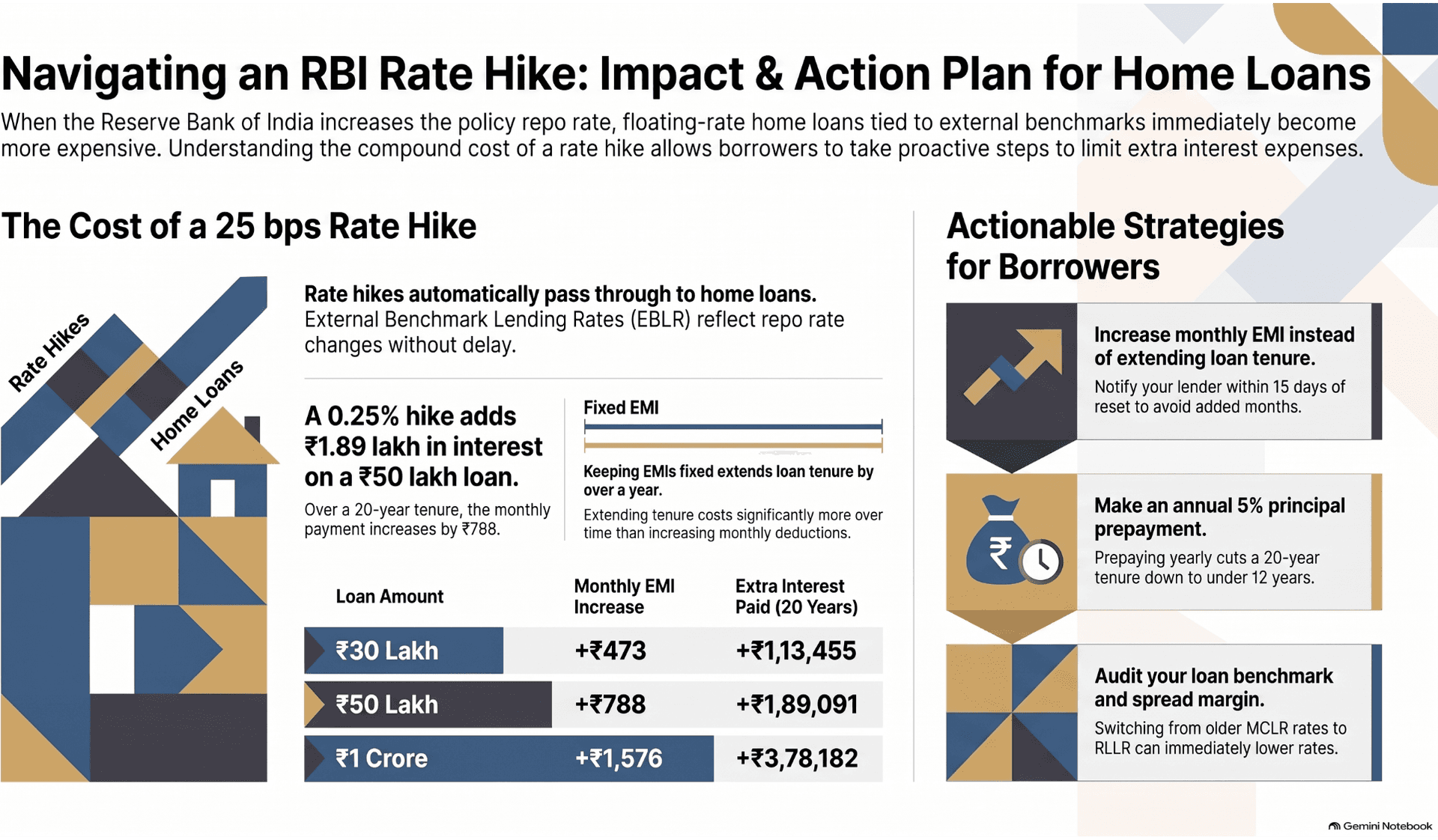
RBI's October 2026 MPC meets 5–7 Oct. See what a hold, cut or hike in the repo rate would do to your home loan EMI in Tricity, with worked examples.
The Reserve Bank of India's Monetary Policy Committee meets from 5 to 7 October 2026, with the interest rate decision announced on 7 October. Coming off four consecutive policy pauses, this meeting arrives at a difficult moment.
Retail inflation has been climbing and global commodity pressure is building, so home loan borrowers have a direct stake in whether borrowing costs hold or rise.
[UPDATE AFTER MPC] — this article was written before the decision. The hike below is modelled as a scenario, not reported as an outcome.
1. The macro picture: why rates are under pressure
The repo rate stands at 5.25%, after a cumulative reduction of 125 basis points through 2025. Domestic growth remains resilient, with FY27 GDP growth projected around 6.7% — but four pressures have shifted expectations ahead of the October review.
Rising CPI inflation. Consumer price inflation has risen for four consecutive months, reaching 4.82% in August 2026, up from 3.93% in May, 4.38% in June and 4.45% in July. That puts headline inflation comfortably above the RBI's medium-term target of 4.0%.
Global energy costs. Brent crude has traded near $107 a barrel, driven by supply chain constraints and geopolitical friction near the Strait of Hormuz. High energy prices feed straight into domestic transport and production costs.
Currency depreciation. The rupee traded around 96.15 to the US dollar in late September 2026, raising the cost of imported commodities and the risk of imported inflation.
Foreign portfolio outflows. Foreign investors withdrew roughly $3.7 billion from Indian capital markets in September 2026, putting liquidity and rate spreads under scrutiny.
A fifth consecutive hold at 5.25% remains possible. But a growing number of analysts expect a 25 basis point rise to 5.50%, which would be the first increase since February 2023.
2. How a repo rate change reaches your home loan
Since October 2019, Indian banks have benchmarked all floating-rate retail home loans to external benchmarks, mostly the RBI repo rate. These are structured as Repo Rate Linked Lending Rates (RLLR) or External Benchmark Lending Rates (EBLR).
The arithmetic is simple:
Effective home loan rate = RBI repo rate + bank spread
- RBI repo rate — the benchmark policy rate, currently 5.25%.
- Bank spread — the lender's operating margin and credit risk premium, typically 2.75% to 3.50% depending on your credit score and profile.
Because EBLR loans carry mandatory periodic reset clauses — usually every three months — a policy change passes through to what you actually pay. There is no negotiation step and no delay beyond the reset.
3. What a 25 bps hike does to the money
Take a borrower on an effective rate of 8.25% (5.25% repo plus a 3.00% spread) over a 20-year tenure, and model the rate moving to 8.50%.
The monthly instalment is the standard reducing-balance figure:
EMI = P × r × (1 + r)ⁿ ÷ ((1 + r)ⁿ − 1)
where P is the principal, r the monthly rate (annual rate ÷ 12 ÷ 100) and n the tenure in months — 240 for twenty years.
Impact on your monthly outgo
| Loan amount | EMI at 8.25% | EMI at 8.50% | Monthly increase | Extra interest over 20 years |
|---|---|---|---|---|
| ₹30 lakh | ₹25,562 | ₹26,035 | +₹473 | +₹1,13,455 |
| ₹50 lakh | ₹42,603 | ₹43,391 | +₹788 | +₹1,89,091 |
| ₹75 lakh | ₹63,905 | ₹65,087 | +₹1,182 | +₹2,83,636 |
| ₹1 crore | ₹85,207 | ₹86,782 | +₹1,576 | +₹3,78,182 |
The monthly increase looks survivable. The right-hand column is the one worth reading twice: on a ₹50 lakh loan, a quarter-point costs ₹1.89 lakh over the life of the loan.
You can run your own numbers on our EMI calculator — it shows the same reducing-balance figure, plus a year-by-year breakdown of how little of the early years is actually repayment.
If you keep the EMI fixed instead
When rates rise, banks commonly default to extending the tenure rather than increasing the monthly deduction. It feels painless, because nothing changes in your bank statement.
Hold the EMI at its 8.25% level after a rise to 8.50% and the tenure extends by 12.1 months — a full extra year, and the figure is the same across every loan size above, because tenure extension depends on the rate change rather than the principal.
That extra year falls at the end of the loan, where instalments are almost entirely principal. Absorbing a hike this way costs materially more over the life of the loan than taking it on the monthly payment.
4. What a borrower can actually do
Tell your lender to apply hikes to the EMI, not the tenure
Do: write to your bank asking that any rate revision be applied by increasing the monthly instalment rather than extending the tenure.
Why: paying an extra ₹788 a month on a ₹50 lakh loan avoids adding twelve months of instalments at the tail of the loan — over ₹5.2 lakh in gross payments.
When: within 15 days of receiving the rate reset notice.
Set up an annual lump-sum prepayment
Do: commit to an annual partial prepayment of about 5% of the outstanding principal, from a bonus, a tax refund or surplus savings.
Why: on a 20-year ₹50 lakh loan at 8.50%, a ₹2.5 lakh prepayment each year brings the tenure down from 20 years to under 12, cutting total interest by more than a third.
When: set a recurring calendar trigger at each financial year end.
Audit your benchmark and your spread
Do: check whether your loan is still on an older framework — MCLR or Base Rate — or whether your RLLR spread is above what the market now offers.
Why: older MCLR loans often sit at effective rates of 9.00% to 9.50%. Moving to an RLLR benchmark can cut 50 to 100 basis points immediately.
When: now. Conversion fees are typically ₹1,000 to ₹5,000, which a single month's saving often covers.
Compare balance transfer offers
Do: measure your effective rate against transfer offers from other lenders, particularly if your credit score is above 750.
Why: a reduction of 0.35% to 0.50% on a ₹75 lakh loan saves ₹1,600 to ₹2,300 a month.
When: before you move, work out the break-even point including processing fees, legal verification and valuation charges. A transfer that takes three years to pay for itself is not a saving if you plan to prepay aggressively.
What this means if you are buying in the Tricity
A quarter-point does not change whether a flat in Zirakpur or Mohali is worth buying. It changes what you can comfortably borrow — and that is the number worth re-checking before you commit to a booking amount.
Our home loan eligibility calculator works backwards from your income and existing obligations to what a lender is likely to advance, so you can see the effect of a rate change on your budget rather than on a single instalment.
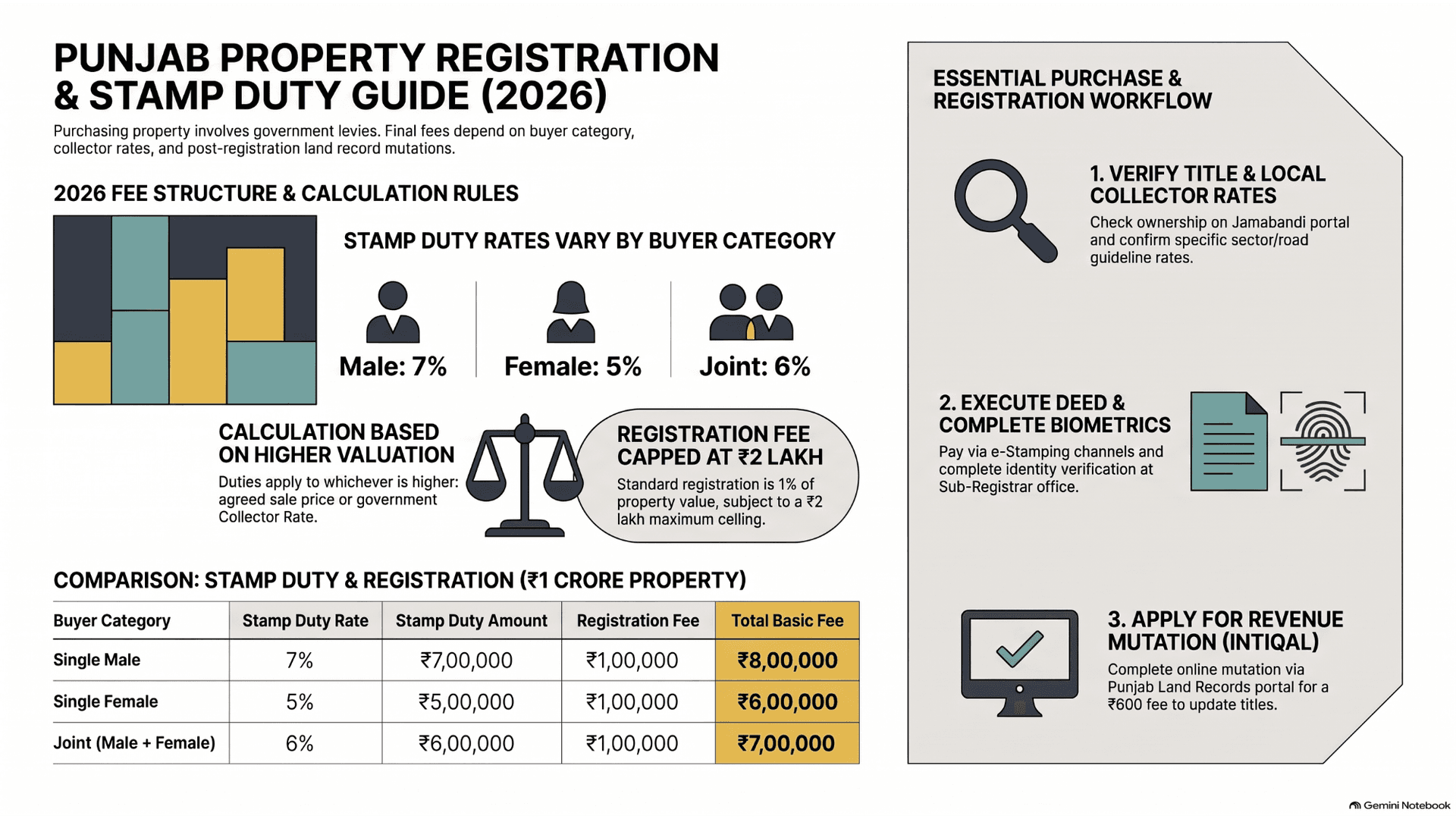
Also worth reading: stamp duty and registration charges in Punjab, which is the other cost most buyers underestimate.
Disclaimer: This article is general information, not financial advice. The MPC decision referenced had not been announced at the time of writing. Interest rates, spreads and lender policies change; confirm the current position with your lender before acting. EMI figures are computed on a standard reducing-balance basis and exclude processing fees, insurance and any other charges a lender may apply.