Stamp Duty and Registration in Punjab 2026: Full Calculation
Punjab stamp duty and registration charges 2026 explained — 7% for men, 5% for women, plus registration fee, with worked examples for Tricity buyers.
Buying a property in Punjab involves more than paying the agreed property price. Buyers also need to budget for stamp duty, registration charges and other applicable government fees before the sale deed can be registered.
For property buyers in Mohali, Zirakpur, Kharar, Dera Bassi and the wider Chandigarh Tricity region, understanding these charges is particularly important because the applicable amount can depend on the property value, buyer category, location, collector rate and nature of the transaction.
This guide explains the Punjab stamp duty rates for 2026, registration charges, how the taxable value is determined, worked examples, the registration process, mutation and important points buyers should check before completing a property purchase.
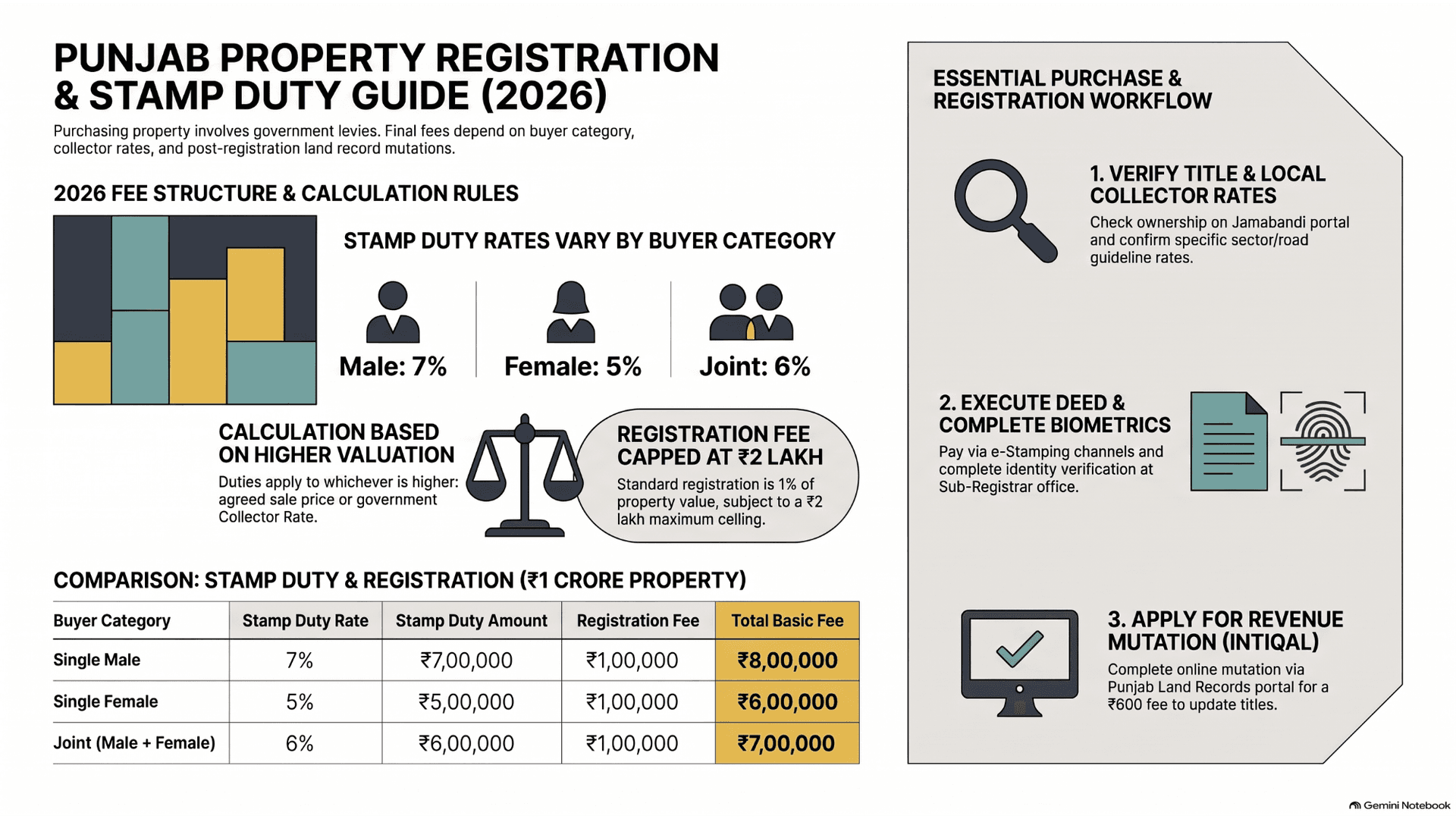
Quick Summary: For a typical sale transaction, commonly published 2026 rates are 7% stamp duty for a male buyer, 5% for a female buyer and 6% for a joint male-female purchase, with registration fee generally calculated at 1% and subject to the applicable maximum of ₹2 lakh. Additional charges or levies may apply depending on the property and location. Always verify the final amount generated by the Punjab registration system before payment.
1. Punjab Stamp Duty and Registration Charges 2026
Stamp duty is a government levy payable on instruments such as sale deeds and certain other property documents. Registration fee is charged for registering the document with the Sub-Registrar.
For a standard property purchase, the commonly published Punjab rates are:
| Buyer Category | Stamp Duty | Registration Fee |
|---|---|---|
| Single Male Buyer | 7% | 1%* |
| Single Female Buyer | 5% | 1%* |
| Joint Male + Female | 6% | 1%* |
| Joint Male + Male | 7% | 1%* |
| Joint Female + Female | 5% | 1%* |
*Registration fee is generally 1% of the applicable value, subject to the prescribed maximum of ₹2 lakh for relevant transactions. Additional government charges may apply depending on the property and jurisdiction.
What does this mean for a buyer?
For example, if a property is valued at ₹1 crore and the applicable value for registration is also ₹1 crore:
- Male buyer: 7% stamp duty = ₹7 lakh
- Female buyer: 5% stamp duty = ₹5 lakh
- Joint male + female: 6% stamp duty = ₹6 lakh
- Registration fee: approximately ₹1 lakh
Therefore, before considering other charges, a ₹1 crore purchase could involve approximately:
| Buyer | Stamp Duty | Registration | Basic Total |
|---|---|---|---|
| Male | ₹7,00,000 | ₹1,00,000 | ₹8,00,000 |
| Female | ₹5,00,000 | ₹1,00,000 | ₹6,00,000 |
| Joint Male + Female | ₹6,00,000 | ₹1,00,000 | ₹7,00,000 |
The actual amount should be calculated using the value accepted by the registration system and after considering any applicable cess or other government charges.
2. How Is Stamp Duty Calculated?
One of the most important things for a property buyer to understand is that stamp duty is not necessarily calculated only on the price mentioned in the sale agreement.
The applicable value can be affected by the higher of the declared transaction value and the applicable Collector Rate, subject to the rules applicable to that particular transaction and property.
Example
Suppose you agree to purchase an apartment in Zirakpur for:
Sale price: ₹80 lakh
But the applicable government valuation based on the Collector Rate and property parameters comes to:
₹85 lakh
The registration calculation may therefore be based on the applicable higher value rather than simply the ₹80 lakh negotiated price.
This is why buyers should check the applicable Collector Rate before finalising the transaction.
3. Collector Rates in Mohali, Zirakpur, Kharar and Dera Bassi
Collector Rates, sometimes referred to as circle rates or government guideline values, are important when calculating property registration costs.
They can vary significantly between different locations.
For example, rates may differ between:
- Mohali sectors
- New Chandigarh
- Kharar
- Zirakpur
- Dera Bassi
- VIP Road
- PR-7 / Airport Road corridors
- Highway-facing properties
- Individual villages and revenue estates
A buyer should therefore avoid assuming that one Collector Rate applies throughout an entire city or tehsil.
Before registration, verify the current applicable rate for the specific locality, property category and transaction.
4. Additional Charges You Should Check
Stamp duty and registration fee are not necessarily the only amounts appearing on a property registration calculation.
Depending on the transaction and location, the registration calculation may include items such as:
- Stamp duty
- Registration fee
- Social Infrastructure Cess or other applicable cess
- Punjab Infrastructure Development Board-related charges, where applicable
- Infrastructure Development Fee, where applicable
- Mutation fee
- PLRS facilitation charges
- Pasting charges
- Service charges
- Applicable taxes on certain services
Government registration receipts can contain several separate components. For example, Punjab government property-registration documents available through Punjab RERA records show registration fee, mutation fee, PLRS facilitation charges and infrastructure-related charges as separate line items.
Important: Do not calculate your final registration budget simply by multiplying the property price by 8% or 6%. Use the current government calculation for the specific transaction.
5. Stamp Duty Calculation Examples
The following examples illustrate the basic stamp-duty and registration calculation.
They are indicative examples, not a substitute for the final government-generated fee calculation.
Property Value: ₹50 Lakh
| Buyer | Stamp Duty | Registration Fee | Basic Total |
|---|---|---|---|
| Male | ₹3,50,000 | ₹50,000 | ₹4,00,000 |
| Female | ₹2,50,000 | ₹50,000 | ₹3,00,000 |
| Joint Male + Female | ₹3,00,000 | ₹50,000 | ₹3,50,000 |
Property Value: ₹75 Lakh
| Buyer | Stamp Duty | Registration Fee | Basic Total |
|---|---|---|---|
| Male | ₹5,25,000 | ₹75,000 | ₹6,00,000 |
| Female | ₹3,75,000 | ₹75,000 | ₹4,50,000 |
| Joint Male + Female | ₹4,50,000 | ₹75,000 | ₹5,25,000 |
Property Value: ₹1 Crore
| Buyer | Stamp Duty | Registration Fee | Basic Total |
|---|---|---|---|
| Male | ₹7,00,000 | ₹1,00,000 | ₹8,00,000 |
| Female | ₹5,00,000 | ₹1,00,000 | ₹6,00,000 |
| Joint Male + Female | ₹6,00,000 | ₹1,00,000 | ₹7,00,000 |
Property Value: ₹2.5 Crore
At ₹2.5 crore, a 1% registration fee would mathematically be ₹2.5 lakh, but where the applicable ₹2 lakh ceiling applies, the registration fee would be capped at ₹2 lakh.
| Buyer | Stamp Duty | Registration Fee* | Basic Total |
|---|---|---|---|
| Male | ₹17,50,000 | ₹2,00,000 | ₹19,50,000 |
| Female | ₹12,50,000 | ₹2,00,000 | ₹14,50,000 |
| Joint Male + Female | ₹15,00,000 | ₹2,00,000 | ₹17,00,000 |
*Subject to the transaction being one to which the prescribed ₹2 lakh registration-fee ceiling applies.
6. Is There a Stamp Duty Concession for Women in Punjab?
Punjab provides a lower stamp-duty rate for female buyers in the commonly published rate structure.
The frequently cited rates are:
- Male buyer: 7%
- Female buyer: 5%
- Joint male + female: 6%
This means that on a ₹1 crore transaction, the difference in the basic stamp-duty component between a male-only and female-only purchase is ₹2 lakh.
However, ownership should be structured according to the buyer's actual ownership, financing, succession and legal requirements rather than solely for reducing registration costs.
7. Tax Benefit on Stamp Duty and Registration Charges
Stamp duty and registration charges can have income-tax implications for eligible taxpayers.
Under the applicable provisions of Section 80C, certain payments relating to purchase or construction of a house property can qualify for deduction, subject to the conditions of the Income Tax law.
The overall Section 80C deduction limit is ₹1.5 lakh for eligible payments covered by the provision. The Income Tax Department's current guidance lists housing-related payments among the qualifying Section 80C categories.
Important points
- The ₹1.5 lakh limit is an aggregate Section 80C limit, not a separate ₹1.5 lakh limit exclusively for stamp duty.
- Your other eligible Section 80C payments can reduce the amount available.
- Eligibility depends on the applicable tax provisions and conditions.
- The tax treatment can differ depending on whether the taxpayer is using the old or new tax regime and the nature of the transaction.
- For a significant property purchase, buyers should confirm eligibility with a tax professional before claiming the deduction.
Do not treat the stamp-duty amount as an automatic tax refund.
8. Step-by-Step Property Registration Process in Punjab
The registration process involves several stages. Buyers should complete their legal and title checks before making the final payment.
Step 1: Verify Title and Land Records
Before purchasing a property, verify the seller's ownership and relevant property records.
The Punjab Land Records portal provides access to services including:
- Jamabandi
- Fard
- Mutation records
- Registered deeds
- Roznamcha
- Land-record searches
The portal allows searches using information such as owner name, Khewat number, Khasra number and Khatouni number.
Punjab Land Records / Jamabandi Portal
For a resale property, your lawyer should also check the previous chain of title, encumbrances, pending disputes, mortgages, development permissions and applicable NOCs.
Step 2: Verify the Property's Collector Rate
Check the current Collector Rate applicable to the property.
This is particularly important in the Tricity because property values and government rates can differ substantially between sectors, villages, roads and development areas.
For an apartment, also verify the relevant property classification and the valuation methodology used by the registration system.
Step 3: Draft the Sale Agreement and Sale Deed
Have the sale agreement and sale deed prepared or reviewed by a qualified property lawyer.
The documents should accurately describe:
- Buyer and seller
- Property address
- Unit/plot number
- Floor and tower, where applicable
- Carpet/built-up/super area as relevant
- Land share, where applicable
- Sale consideration
- Payment schedule
- Possession
- Existing mortgage or loan
- NOCs
- Parking
- Fixtures and fittings
- Default and indemnity provisions
- Encumbrances and title representations
For a property purchased from a developer, the buyer should also examine the allotment letter, builder-buyer agreement, RERA information, payment schedule and possession terms.
Step 4: Arrange Stamp Duty and Registration Payments
The required stamp duty and registration-related payments can be generated through the applicable Punjab registration/e-stamping process.
Use official channels and retain all payment receipts and transaction references.
Do not rely solely on an informal calculation from a broker or property seller.
Step 5: Complete Registration at the Sub-Registrar Office
On the scheduled registration date, the parties and required witnesses/identifiers should attend the designated registration office with the necessary original documents and identification.
Depending on the transaction, the registration process can involve:
- Verification of the parties
- Verification of the document
- Photograph capture
- Biometric authentication
- Document execution
- Digital/electronic registration
- Payment verification
- Registration of the deed
The exact document requirements can vary according to the transaction and current registration rules.
Step 6: Obtain the Registered Deed
After successful registration, retain the registered sale deed and all associated receipts.
Punjab Land Records also provides a facility to search/view registered deeds.
Keep digital and physical copies of:
- Registered sale deed
- Stamp-duty receipt
- Registration-fee receipt
- Payment receipts
- Possession documents
- NOCs
- Previous title documents
- Property tax records, where applicable
9. Mutation / Intiqal After Property Registration
Registration of the sale deed and mutation are related but distinct processes.
Mutation records the change in the revenue record following the transaction.
Punjab Land Records provides an online service specifically for:
"Request for Mutation on the basis of Registered Deed."
The current government portal specifies a ₹600 government fee per mutation for this service.
Apply for Mutation on Punjab Land Records
Buyers should ensure that the mutation process is completed and subsequently verify the updated revenue record where applicable.
10. Important Checks for Mohali, Zirakpur, Kharar and Dera Bassi Buyers
If you are purchasing property in the Chandigarh Tricity region, the following checks can prevent unexpected costs and documentation problems.
Check the exact jurisdiction
A property marketed as "Mohali" or "Zirakpur" may fall under a particular municipal, development-authority, tehsil or revenue jurisdiction.
Confirm the actual jurisdiction from the property documents.
Verify the exact Collector Rate
Do not rely on a city-wide rate.
Collector Rates can vary by:
- Sector
- Village
- Road
- Property type
- Land use
- Municipal limits
- Development category
Check applicable cess and development charges
The final government calculation can contain additional components beyond basic stamp duty and registration fee.
Check the registration-fee ceiling
For transactions where the prescribed ₹2 lakh maximum applies, the registration fee does not continue increasing indefinitely at 1%.
This becomes particularly relevant for properties priced above ₹2 crore.
Verify developer/RERA information
For an under-construction or recently launched project, check the project's Punjab RERA registration and approved project details before making substantial payments.
11. Stamp Duty on Different Types of Property Transactions
Stamp duty is not the same for every type of document.
Depending on the transaction, different rules and rates may apply to:
- Sale deed
- Gift deed
- Transfer deed
- Mortgage deed
- General Power of Attorney
- Special Power of Attorney
- Cancellation deeds
- Partition documents
- Lease deeds
- Family transfers
Therefore, do not use the standard residential sale-deed rate for another type of transaction without checking the applicable stamp-duty schedule.
For example, a property transfer within a family can have substantially different stamp-duty treatment from a normal market sale, but the exact eligibility depends on the nature of the document and relationship.
12. Common Mistakes Property Buyers Should Avoid
Mistake 1: Calculating charges only on the negotiated price
The applicable government valuation may be higher.
Mistake 2: Assuming all Tricity properties have the same rates
Mohali, Kharar, Zirakpur and Dera Bassi can have different local valuation and jurisdictional considerations.
Mistake 3: Ignoring additional government charges
The final registration calculation can contain charges beyond stamp duty and registration.
Mistake 4: Treating registration as a substitute for title verification
Registration does not mean a buyer should skip independent legal due diligence.
Mistake 5: Not checking the seller's title chain
Always examine previous deeds, mutation entries and relevant revenue records.
Mistake 6: Forgetting mutation
After registration, ensure that the ownership change is appropriately reflected in the relevant revenue records.
Mistake 7: Assuming tax benefits are automatic
Section 80C eligibility depends on the applicable tax rules and the taxpayer's circumstances.
13. Frequently Asked Questions
What is the stamp duty rate in Punjab in 2026?
For standard property transactions, commonly published rates are 7% for male buyers, 5% for female buyers and 6% for joint male-female ownership. The applicable rate can depend on the nature of the transaction and current government rules.
What is the registration fee in Punjab?
The commonly published registration fee is 1% of the applicable value, with a maximum of ₹2 lakh for transactions to which that ceiling applies. Additional charges may be payable.
Is registration cheaper if a property is purchased in a woman's name?
Punjab's commonly published rate structure provides a lower stamp-duty rate for a female buyer. The standard comparison is 5% for a female buyer versus 7% for a male buyer.
However, ownership should be decided based on genuine ownership, financing, succession and legal considerations rather than registration cost alone.
How is stamp duty calculated?
The applicable valuation generally considers the transaction value and the government-prescribed valuation/Collector Rate, with the higher applicable value generally determining the duty base.
What is the mutation fee in Punjab?
The Punjab Land Records portal currently specifies a ₹600 government fee per mutation for mutation based on a registered deed.
Can mutation be applied for online?
Yes. Punjab Land Records provides an online service for requesting mutation on the basis of a registered deed.
Can I check Jamabandi online?
Yes. Punjab's land-record portal provides online access to Jamabandi and other land-record services.
Is stamp duty on property eligible for an income-tax deduction?
Certain eligible house-property payments can qualify under Section 80C, subject to the applicable conditions and the overall ₹1.5 lakh Section 80C limit. Taxpayers should verify their eligibility under the tax regime applicable to them.
Do I need a lawyer to register property in Punjab?
A lawyer is not necessarily the person who performs the registration, but independent legal review is strongly advisable for a property purchase, particularly for resale property, land, high-value transactions or transactions involving complicated title history.
How much money should I keep aside for property registration?
Do not budget only for the headline stamp-duty percentage.
A buyer should account for:
Stamp Duty + Registration Fee + Applicable Cess/Development Charges + Mutation + Facilitation/Service Charges + Legal/Documentation Costs
The exact amount should be confirmed before registration using the applicable government calculation.
14. Property Registration Checklist for Punjab Buyers
Before visiting the registration office, keep a checklist of the following:
Buyer Documents
- Aadhaar/valid identity document
- PAN
- Address proof, where required
- Passport-size photographs, where required
- Payment details
- Loan documents, if applicable
Seller Documents
- Aadhaar/identity document
- PAN
- Original title deed
- Previous chain of title
- Mutation/revenue records
- Relevant NOCs
- Property tax documents, where applicable
- Bank NOC/release letter, if the property was mortgaged
Property Documents
- Sale agreement
- Sale deed
- Property identification details
- Collector Rate/valuation details
- Approved plan, where applicable
- RERA documents, where applicable
- Possession documents
- Parking documents, where applicable
The exact requirements can vary according to the type of transaction.
15. Final Takeaway
For anyone buying property in Mohali, Zirakpur, Kharar, Dera Bassi or another part of Punjab, stamp duty and registration charges can represent a significant additional cost.
The headline rates are only the starting point. The actual amount depends on the property value, Collector Rate, buyer category, transaction type, jurisdiction and applicable government charges.
Before signing the final sale deed:
- Verify the seller's title.
- Check Jamabandi and mutation records.
- Verify the current Collector Rate.
- Confirm the applicable stamp duty.
- Check the registration-fee ceiling.
- Identify any additional cess or development charges.
- Have the sale deed legally reviewed.
- Complete registration through the authorised process.
- Obtain and preserve the registered deed.
- Complete and verify mutation after registration.
For current government information, buyers should rely on the Punjab Land Records and registration systems rather than an old calculator or an outdated property article.
Useful Government Resources
Punjab Land Records / Jamabandi — jamabandi.punjab.gov.in
StockHolding e-Stamping — shcilestamp.com
Income Tax Department — incometax.gov.in
Related Guides
Disclaimer: This article is intended for general information and property-planning purposes. Government fees, Collector Rates, cess, registration procedures and tax provisions can change through notifications or amendments. The final amount applicable to a property should be confirmed through the relevant Punjab government registration authority or a qualified property/tax professional before completing the transaction.